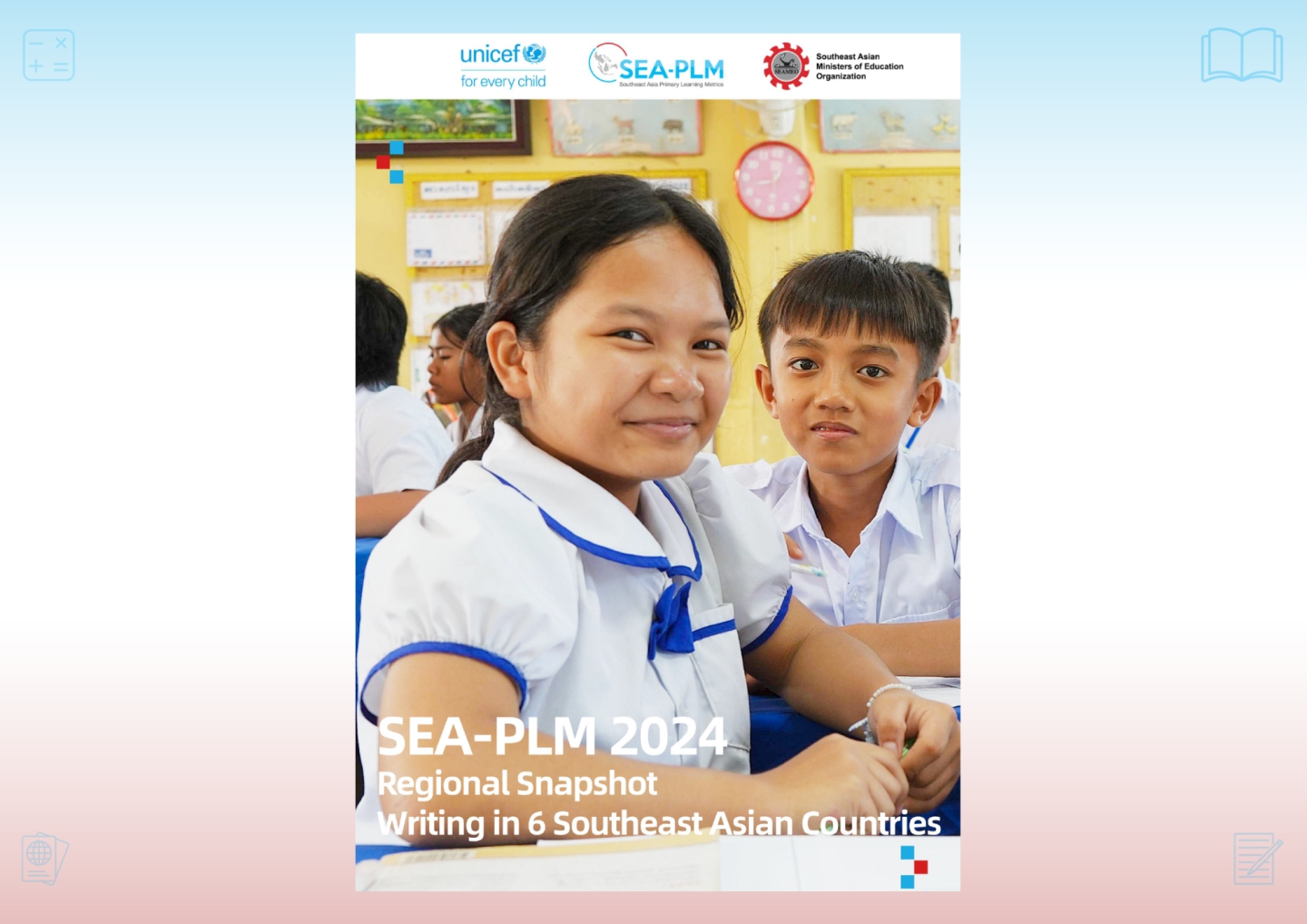
The SEA-PLM 2024 Regional Snapshot on Writing brings new attention to children’s ability to express ideas in writing, showing that while many Grade 5 students can produce simple and relevant texts, large disparities remain across and within countries, particularly by socioeconomic background, gender, and the language spoken at home.
The SEA-PLM 2024 Regional Snapshot on Writing offers a broader view of foundational learning in Southeast Asia by focusing on a skill that is essential, but often less visible in large-scale assessment reporting. Implemented by all six participating countries in the 2024 cycle, the writing domain complements previously released findings in reading, mathematics, and contextual factors, and helps complete the picture of how children are learning across the region.
Regional results indicate that many Grade 5 students are still developing foundational writing skills. Overall, 31.2 per cent of students were in Proficiency Band 3, demonstrating the ability to generally write simple texts with relevant ideas. Meanwhile, 21.8 per cent reached Band 4, and 5.4 per cent attained Band 5, reflecting stronger abilities to produce more detailed, cohesive texts using a wider range of vocabulary. At the same time, the findings underscore persistent challenges in writing proficiency across the region. Around one in five students (20.2 per cent) performed at Band 1 and below, while a further 21.4 percent were in Band 2. These results suggest that a substantial proportion of children continue to face difficulties in expressing their ideas clearly and effectively in writing.
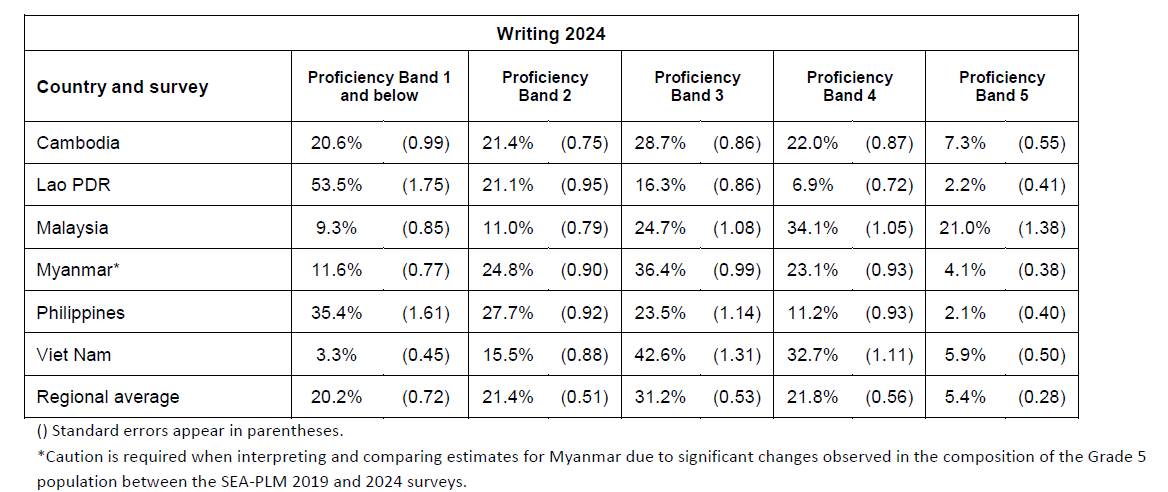
2024 Distribution of Writing Proficiency Levels
The snapshot also reveals wide variation across countries. With 3 countries (Cambodia, Malaysia, and Viet Nam) demonstrating national performance above the regional average, with Myanmar recording a high performance, caution is required in interpreting its results because of changes in the Grade 5 population between survey cycles. The rest of the countries (Lao PDR and the Philippines) performed below the regional average and had a significant share of children in Band 1 and below.
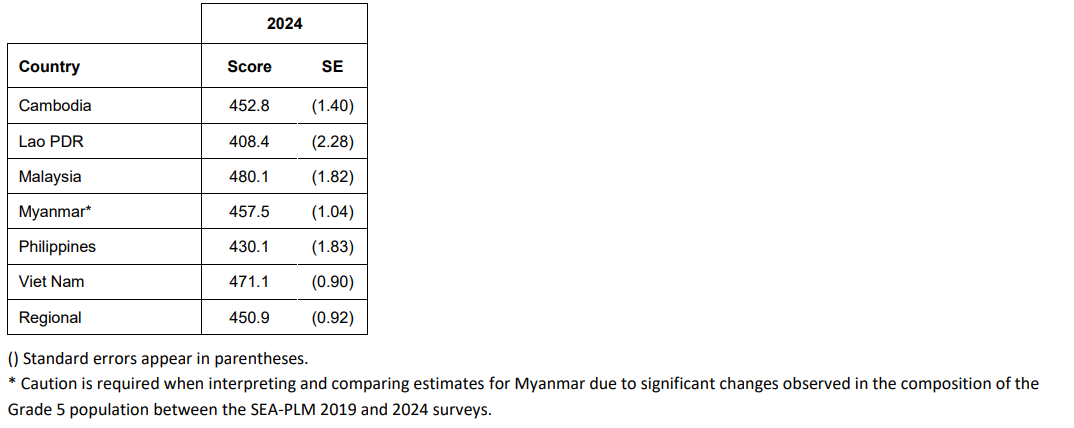
2024 National Average Scores in Writing
The findings also point to persistent inequities in writing achievement. In every participating country, students from the highest socioeconomic quartile outperformed those from the lowest quartile, with score gaps ranging from 21.9 to 56.5 points. Girls outperformed boys in all six countries, with differences ranging from 13 to 22.6 points. In addition, children who spoke the language of instruction at home generally performed better than those who did not, with statistically significant differences observed in four countries.
The report stresses that the 2024 writing results should not be directly compared with those from 2019. SEA-PLM delayed the release of the writing findings after a technical review found that changes in coding, quality assurance, and scoring procedures may have affected cross-cycle comparability. While this means the 2024 results cannot be used to measure trends against 2019, the snapshot confirms that the data remain robust and reliable for understanding writing performance within the 2024 cycle and across participating countries.
Taken together, the findings underline the importance of writing as a core part of foundational learning. It also reinforces a familiar message from across the region: learning outcomes are shaped not only by what children are taught, but by the opportunities and support available to them at home and in school. The full SEA-PLM 2024 Regional Report on Writing, scheduled for release in Q2 2026, is expected to provide further analysis to support more inclusive and responsive education policies.