Jakarta, June 1016 - SEA-PLM participated in the SEAMEO Centres Policy Research Network (CPRN) Summit 2026. Held from 9 to 11 June 2026 in Jakarta, Indonesia, the summit gathered policymakers, researchers, education practitioners and development partners under the theme “Bridging Research, Policy, and Practice: Pathways toward Inclusive, Equitable, and Sustainable Futures.” The event provided a timely space to discuss how regional evidence can be translated into practical improvements across education systems.
Representing the SEA-PLM Regional Secretariat, Mr Alejandro Sinon Ibanez joined a plenary session examining the urgency of numeracy and the system-level reforms needed to improve mathematics learning. His presentation, “Turning Evidence into Action: Numeracy Outcomes and Policy Responses from the Southeast Asia Primary Learning Metrics,” drew on findings from the SEA-PLM 2024 Main Regional Report. In the beginning of the presentation , Mr Alejandro invited participants to answer two mathematics questions similar to those given to Grade 5 students. The first was a simple addition problem, while the second asked students to compare the heights of two children using a measurement scale. The questions appeared straightforward to the audience. Yet the results revealed a different reality for children. While between 92 and 98 per cent of Grade 5 students across participating countries could answer the first question correctly, only between 42 and 79 per cent successfully completed the second. This simple exercise helped make the data feel real. It reminded participants that what adults assume children should know does not always reflect what children can actually demonstrate. This is where learning assessments such as SEA-PLM matter; it provides objective evidence about students’ knowledge and skills, allowing education systems to respond to actual learning needs rather than assumptions.
The SEA-PLM 2024 results show modest progress in mathematics across the region. The regional average increased from 305 score points in 2019 to 310 in 2024. However, progress remains uneven among countries and groups of learners. Around 68 per cent of Grade 5 students achieved the minimum proficiency in mathematics, while 32 per cent remained below it. More concerningly, approximately nine per cent demonstrated very low proficiency, performing at a level closer to what would be expected in the earlier years of primary school. This represents nearly half a million Grade 5 students who have completed five years of schooling but are still struggling with foundational mathematical skills.
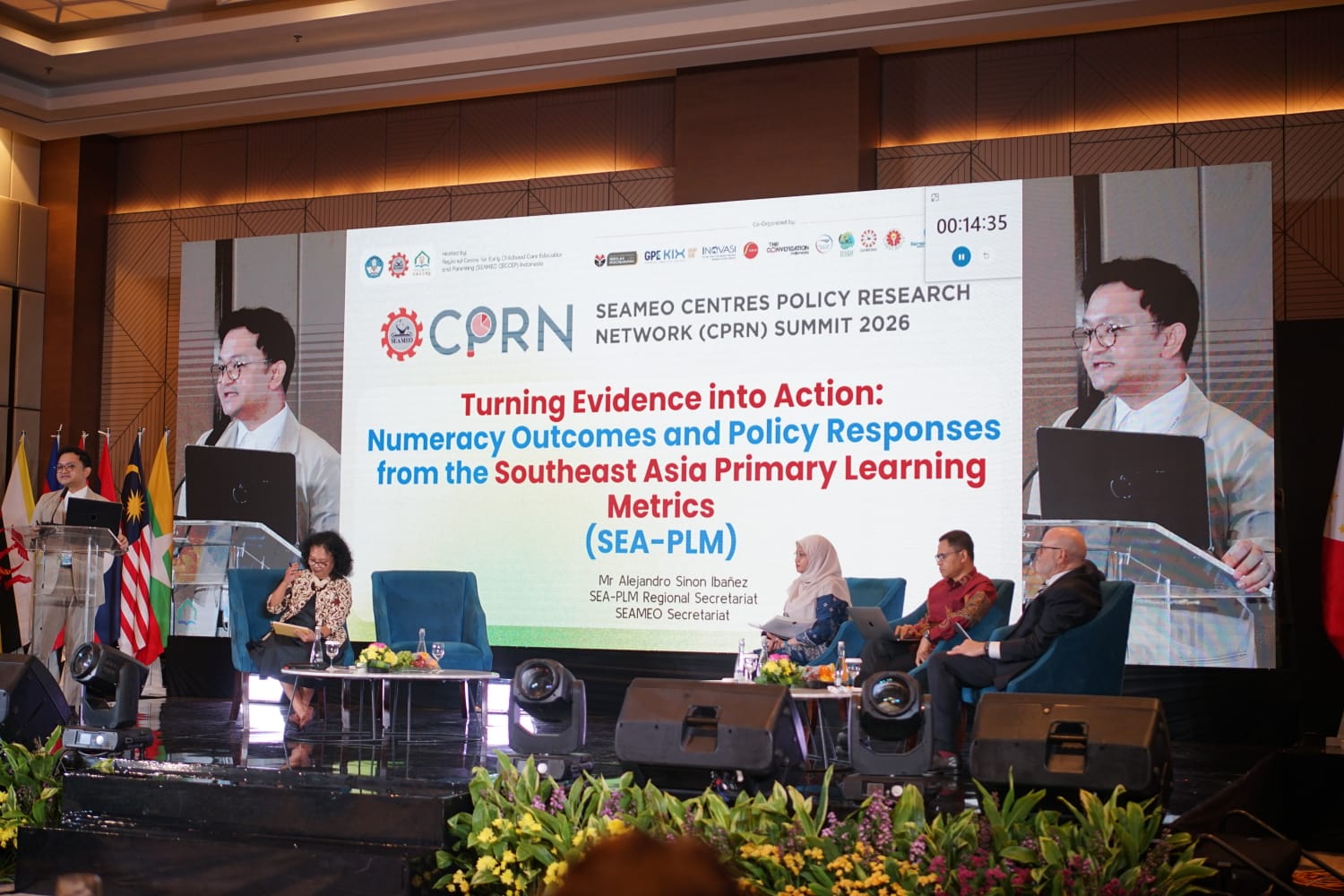
Mr Alejandro Ibanez presented the result of SEA-PLM 2024
The presentation also looked beyond national averages to examine who is learning and who continues to fall behind. While gender differences in mathematics were generally small, the gaps associated with socioeconomic background were far more significant. In some countries, the difference between students from higher- and lower-income households reached almost 30 score points, equivalent to approximately one or two years of learning. Other factors also shaped learning outcomes. Students attending private schools generally performed better than those in public schools, while children who spoke the language of instruction at home achieved higher scores than those who did not. Across participating countries, between nine and 14 per cent of students were enrolled in schools where at least half of the student population was low-performing, revealing pockets of concentrated learning disadvantage.
These findings brought the discussion back to equity. Low mathematics performance cannot be treated only as an individual learning problem. It is closely connected to the conditions surrounding children, their family circumstances, language, school resources and access to early learning opportunities. Improving outcomes therefore requires targeted support for schools and learners facing multiple disadvantages.
Mr Alejandro also highlighted how participating countries are already carrying SEA-PLM evidence forward. National Steering Committees are bringing together policymakers, curriculum specialists, assessment experts and practitioners to examine the findings and connect them with national reforms.
Cambodia is strengthening classroom assessment and early-grade learning. Lao PDR is using item-level analysis to support curriculum and teacher-training reforms. The Philippines is developing teacher capacity and assessment resources linked to the MATATAG curriculum, while Myanmar is focusing on reading fluency and mathematical thinking. Malaysia is exploring the use of artificial intelligence in assessment, teacher development and policymaking, and Viet Nam is using SEA-PLM findings to strengthen school-quality standards and system monitoring. The discussion reinforced a shared understanding that data must lead to decisions, investment and changes in classroom practice. Assessment results are most valuable when teachers can use them to understand learners’ needs, ministries can connect them with national priorities, and countries can learn from one another.
This direction is at the heart of SEA-PLM Initiative 2 on evidence-to-policy, which supports countries in strengthening their capacity to translate learning data into meaningful and sustained action. It also supports the regional vision for SEA-PLM 2029: raising the floor for children who have not yet reached minimum proficiency, narrowing learning gaps, unlocking the potential of higher-performing students and strengthening education systems’ capacity to use evidence.
SEA-PLM’s participation in the CPRN Summit showed that the region already has valuable evidence and growing national commitment. The next step is to keep that evidence moving from reports into policy discussions, from policy discussions into programmes, and from programmes into classrooms.