Advancing Foundational Learning in Southeast Asia
A Regional Learning Assessment and Capacity-Building Programme by and for Southeast Asia
Based on the findings of the SEA-PLM 2024 report, the region has a joint vision to:
- Raise the floor;
- Unlock every student’s potential;
- Narrow the learning gaps; and
- Strengthen education system capacity.
This vision brings Southeast Asian countries together in a collaborative effort to promote learning outcomes for all children in the region.
The SEA-PLM Regional Secretariat launches the next SEA-PLM Pluriannual Strategic Framework 2026-2031 Framework. This five-year cycle will cover the next round of assessment, SEA-PLM 2029 and the continued support to countries, at different levels of the education system, in utilizing evidence and data to inform policies and practices. Ministries of Education of countries and subnational entities(ies) together with interested partners, are invited to start exploring possibilities and options to ensure the assessment meets national and local priorities and responds to national contexts.

How SEA-PLM 2029 Responds to the Regional Vision
SEA-PLM 2029 represents the next phase of the Southeast Asia Primary Learning Metrics programme, covering the period 2026-2031. Building on the lessons and achievements of 2019 and 2024 programme cycles, SEA-PLM 2029 responds to the region’s shared vision of ensuring that every child in Southeast Asia acquires strong foundation learning, supported by education systems that can identify learning needs early, respond effectively to disparities, and continuously improve through the use of evidence.
Anchored in this regional vision, SEA-PLM 2029 goes beyond measuring learning outcomes. It strengthens SEA-PLM as a regional public good that enables countries to generate high-quality evidence, deepen policy dialogue, strengthen national capacities, and foster regional cooperation. By supporting countries to transform learning data into policy and practice, SEA-PLM 2029 introduces a broader and more integrated programme approach that connects assessment with policy action and system improvement.
The programme will:
- Continue to monitor Grade 5 students' learning in reading and mathematics
- Generate richer contextual evidence through questionnaires for students, parents, teachers, schools, and education systems to better understand the factors influencing learning.
- Strengthen countries' capacity to identify learning gaps, monitor equity, and address disparities affecting disadvantaged learners.
- Provide greater flexibility for countries to contextualize programme activities according to national priorities while maintaining regional comparability.
- Expand opportunities for regional collaboration, peer learning, knowledge exchange, and technical cooperation.
- Strengthen SEA-PLM's role as both a regional monitoring mechanism and a catalyst for evidence-informed education reform.
- Advance Initiative 2, which supports countries in translating SEA-PLM evidence into policy development, planning, implementation, monitoring, and continuous system improvement.
Through this integrated approach, SEA-PLM 2029 enables countries to move beyond evidence generation towards sustained evidence-informed decision-making, strengthening education systems that can better support every learner.
SEA-PLM Programme Pillars
SEA-PLM 2029 is guided by three programme pillars:
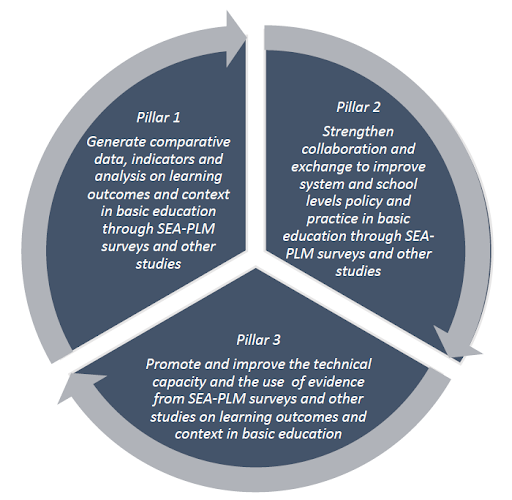
These pillars are implemented through two main initiatives
Initiative 1: SEA-PLM 2029 Survey

Initiative 1 is the flagship assessment component of the programme. The SEA-PLM 2029 survey will measure and compare learning and system changes among grade 5 students across Southeast Asia.
The survey will focus on reading and mathematics as the core domains, while writing will remain optional. It will also include contextual questionnaires for students, parents, teachers, and schools, complemented by system-level questionnaires. These tools will help countries better understand the factors that shape learning, including equity dimensions, learning environments, student background, and broader education system conditions.
SEA-PLM 2029 will remain regionally comparable while allowing participating countries to reflect their national contexts. Assessment tools will be developed through a participatory and consultative process with national technical teams, supported by the SEA-PLM Regional Secretariat and partners.
The main survey is expected to take place in 2029, with the final regional report planned for release in 2030.
Initiative 2: Evidence-to-Policy Linkages

Initiative 2 supports countries in using SEA-PLM evidence and complementary data to improve basic education policies, systems, and practices.
While Initiative 1 focuses on generating high-quality learning data, Initiative 2 focuses on helping countries translate that evidence into policy dialogue, reform priorities, capacity building, research, and practical interventions. It is designed to be demand-driven, flexible, and responsive to each country’s needs.
Initiative 2 may include activities such as:
- Policy review and dialogue.
- Capacity building for ministries and education stakeholders
- Research, evidence, and data initiatives.
- Curriculum mapping.
- Development of classroom-use assessment items.
- Further analysis of SEA-PLM data.
- Support for evidence-informed interventions.
- Peer learning and regional exchange.
Through Initiative 2, SEA-PLM 2029 aims to strengthen the link between assessment results and real improvements in education policy, planning, implementation, and monitoring.