When SEA-PLM releases findings on reading, mathematics and writing, the final figures are only the visible end of a much longer process. Before any result can inform policy, the assessment must define who is represented, select schools and students fairly, capture responses consistently, and place performance on a scale that can be interpreted across countries and, where appropriate, over time.
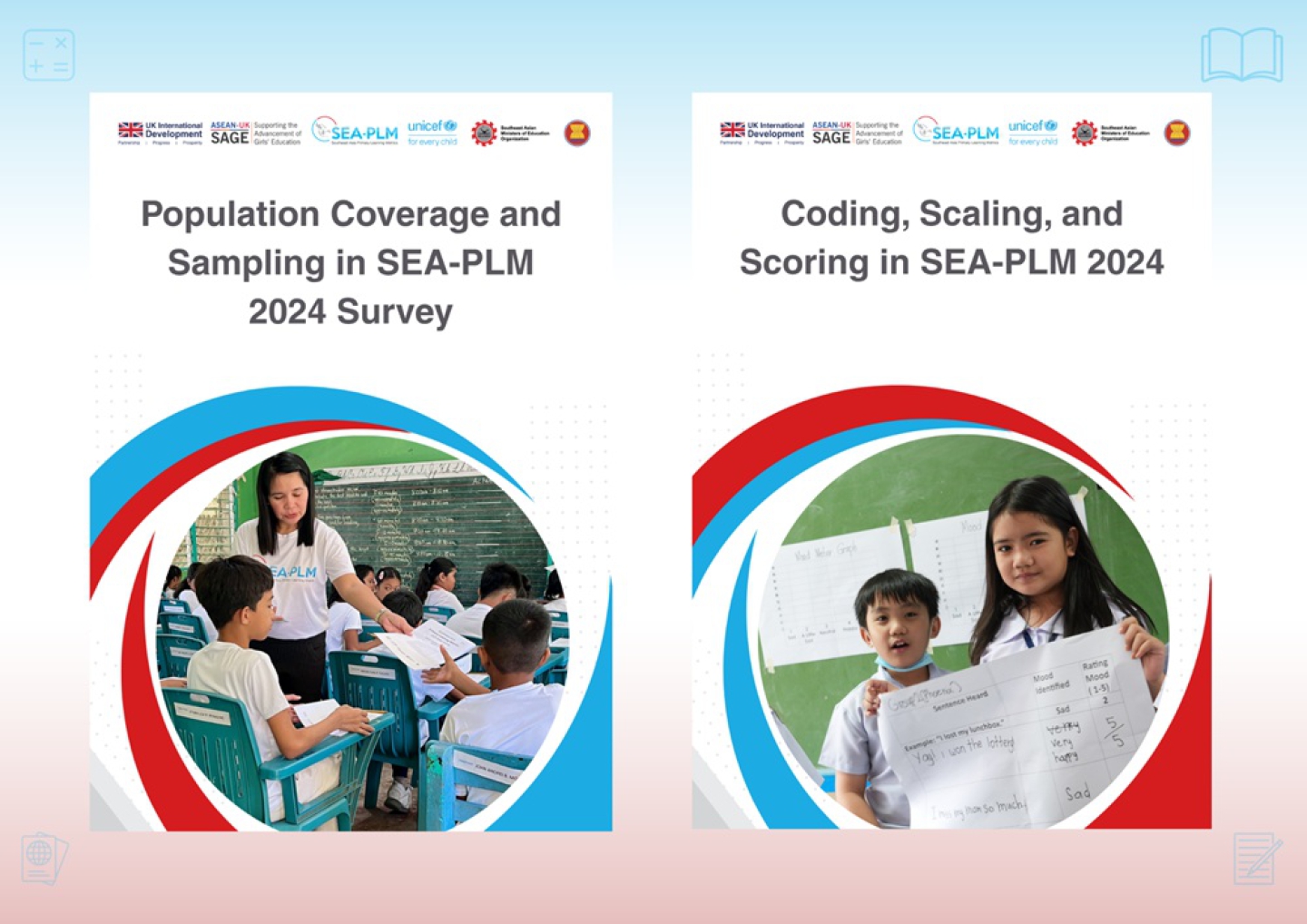
Two companion publications, Population Coverage and Sampling in SEA-PLM 2024 Survey and Coding, Scaling, and Scoring in SEA-PLM 2024, open this process to readers. Together, they show that reliable learning evidence is built through a connected chain of decisions, safeguards and quality checks, from the first school list to the final score.
SEA-PLM 2024 focused on students enrolled in Grade 5, defined as the grade representing five years of schooling from the first year of primary education. This common definition was applied across participating countries while recognising differences in school systems, enrolment structures and national contexts. The goal was not simply to test a large number of children, but to make sure the results reflected the diversity of Grade 5 classrooms across the region.
Participating countries worked from official enrollment data provided by Ministries of Education at the time of data collection. The sampling publication also documents where coverage was reduced because of very small schools, remote locations, special education settings, international schools, or other practical and contextual challenges. This transparency matters: even a small change in population coverage can affect how results should be interpreted.
SEA-PLM used a two-stage stratified cluster sampling method. First, schools were selected using probability proportional to size, so a school's likelihood of selection reflected its number of Grade 5 students. Second, one Grade 5 class was randomly selected within each participating school, and all students in that class were invited to take part.
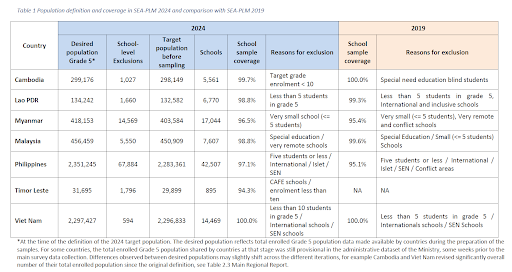
Population definition and coverage in SEA-PLM 2024 and comparison with SEA-PLM 2019
Every participating country exceeded the minimum standard of 150 schools and 4,000 students. In total, 36,662 students took part. Overall response rates were above 90 per cent in every country, with Cambodia and Viet Nam both recording rates above 99 per cent.
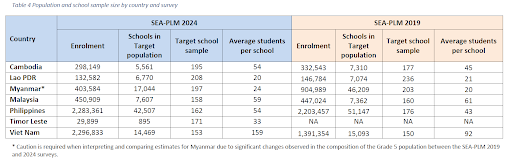
Population and school sample size by country and survey
Oversampling provides participating countries with the flexibility to collect more detailed evidence on specific population groups, geographic areas or education settings that are especially relevant to national priorities. Where needed, countries can supplement the main national sample by selecting additional schools or students from particular subgroups, enabling more precise analysis beyond the overall national estimate. These additional samples are designed in coordination with the sampling contractor so that national analytical needs can be addressed without compromising the representativeness and technical requirements of the main SEA-PLM sample.
Designing an assessment
Once the sample was selected, the next challenge was to collect enough information without overburdening individual students. SEA-PLM 2024 used paper-and-pencil instruments containing a combination of multiple-choice and constructed-response questions. Eighteen rotated test booklets allowed each child to answer a manageable selection of questions in two of the three learning domains. Students had one hour for the test and 30 minutes for the questionnaire.
The language of assessment was selected by each participating country to reflect its national education and linguistic context, while maintaining the common SEA-PLM assessment framework. In some countries, additional language options were used through secondary samples: for example, the Philippines administered the reading assessment in Filipino for its secondary sample. Cambodia also included a secondary sample of students attending multilingual education (MLE) schools. These arrangements allowed countries to respond to their specific language contexts while applying consistent SEA-PLM test design and technical procedures.
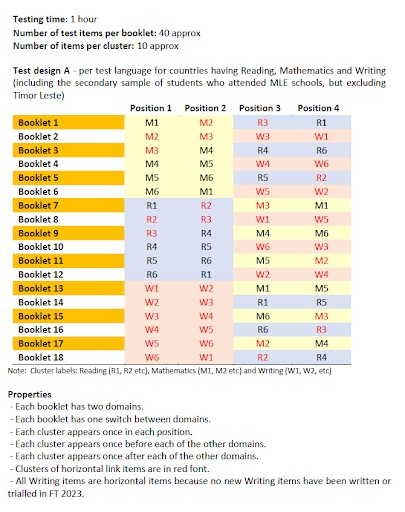
SEA-PLM 2024 used 18 rotated test booklets so students could answer a manageable number of questions while still allowing results to be reported across learning domains.
Coding means matching a student's response to a clear description of performance. Multiple-choice answers can be processed electronically. Constructed responses require trained coders to use detailed guides so that similar answers are treated consistently, whether a child writes a word, a phrase or a number, or shows the steps behind their thinking. These open responses can reveal whether a student understands a passage or a mathematical idea, rather than simply recognising one option among four.
Writing requires even greater care because every task asks students to produce their own text. SEA-PLM 2024 examined content development, organisation, language use, grammatical accuracy, vocabulary, punctuation and spelling. Partial-credit scoring captured different levels of performance instead of reducing each response to a simple correct-or-incorrect judgement.
Compared with the 2019 cycle, SEA-PLM 2024 introduced more direct training, country-level support, double-blind coding, clearer reconciliation procedures and stricter security protocols. Each writing script was marked independently by two coders. Where their judgements differed, responses were reviewed and adjudicated. This strengthened scoring consistency across countries and languages.
New reading and mathematics items were also developed through a regional process involving participating countries and experts from the Australian Council for Educational Research (ACER). Original items submitted by countries were reviewed, trialled and refined alongside ACER-developed items and secure trend items from 2019.
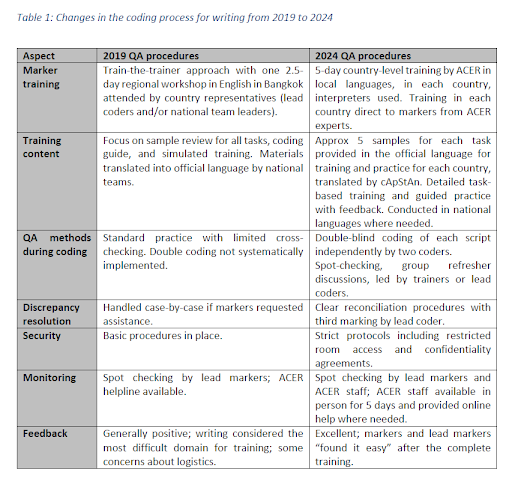
SEA-PLM 2024 strengthened writing quality assurance through country-level training, double-blind coding, clearer reconciliation procedures and stricter security protocols.
Scaling makes it possible to place results from different booklets and groups of students on one measurement scale. SEA-PLM used item response theory methods to estimate student performance and item difficulty. Before final scores were produced, items were reviewed for statistical fit, gender differential item functioning and item-country interaction. In plain language, these checks examined whether questions worked fairly and consistently across groups and countries.
Reading and mathematics results from SEA-PLM 2024 were linked to the 2019 scale through horizontal equating. Secure trend items from the previous cycle provided the bridge. After their stability was reviewed, the 2024 scales were shifted onto the historical 2019 scale, allowing performance to be examined over time.
Writing was treated differently. The behaviour of writing trend items changed substantially between cycles, including an average regional increase of 12.4 per cent in item facilities. SEA-PLM therefore placed 2024 writing results on a new scale instead of equating them to 2019. The implication is clear: 2024 writing results should not be compared directly with those from the earlier cycle.
Data quality from fieldwork to reporting
The work between test administration and final reporting is equally important. SEA-PLM 2024 used the Maple platform to support within-school sampling, instrument allocation, participation tracking and data entry. The process connected class lists, student identifiers, booklet allocation, attendance records and submitted responses. After national teams provided their files, ACER conducted further checks, cleaning and recording to align national datasets with the regional structure.
The final calibration produced strong regional reliability estimates across all three domains. Writing recorded the highest estimates, while mathematics and reading literacy also met strong standards. These figures support confidence that the scales capture performance consistently.

SEA-PLM 2024 reported strong reliability across mathematics, reading literacy and writing, supporting confidence in the final domain scales.
Taken together, the two publications show that learning data is never produced in a single step. It depends on up-to-date school lists, accurate enrollment records, transparent coverage decisions, representative sampling, careful administration, consistent coding, robust scaling and honest reporting of limitations.
For governments and education partners, this is more than a technical lesson. The quality of regional evidence depends heavily on the strength of national education data systems and coordination. When those foundations are sound, SEA-PLM findings can do more than describe where children stand: they can guide decisions about where support is needed and how education systems can respond.
As Southeast Asia continues to prioritise foundational learning, transparency about the measurement process is essential. By opening the 'black box' behind its results, SEA-PLM helps policymakers, researchers and the public understand not only what the data says, but also why they can have confidence in it.
–
SEA-PLM is supported by the Government of the Republic of Korea through the ASEAN-Korea Cooperation Fund (AKCF). Its content is the sole responsibility of the SEA-PLM Regional Secretariat and does not necessarily reflect the views of AKCF.”

|
|
|
|
|
|
|
|